
Plastic became a mass commodity in the 1950s because it was cheap, versatile, and durable. Think of a grocery store with fruits and vegetables shipped from countries all around the world, a variety that even the richest person a hundred years ago would have struggled to get year-round. Or flying thousands of miles in a metal-plastic box with a view that only a small fraction of humans who ever lived have gotten to enjoy, through a plastic window. We put a thin, transparent material on our eyes to correct our vision. And somehow a plastic fibre can also be worn to protect you from a literal gunshot.
Once we throw plastics away, it should be no surprise that they keep doing exactly what we made them do -- survive the weather and wear. After unlocking a whole paradigm shift, the wundermaterial ended up as a poster child of the pollution landscape.
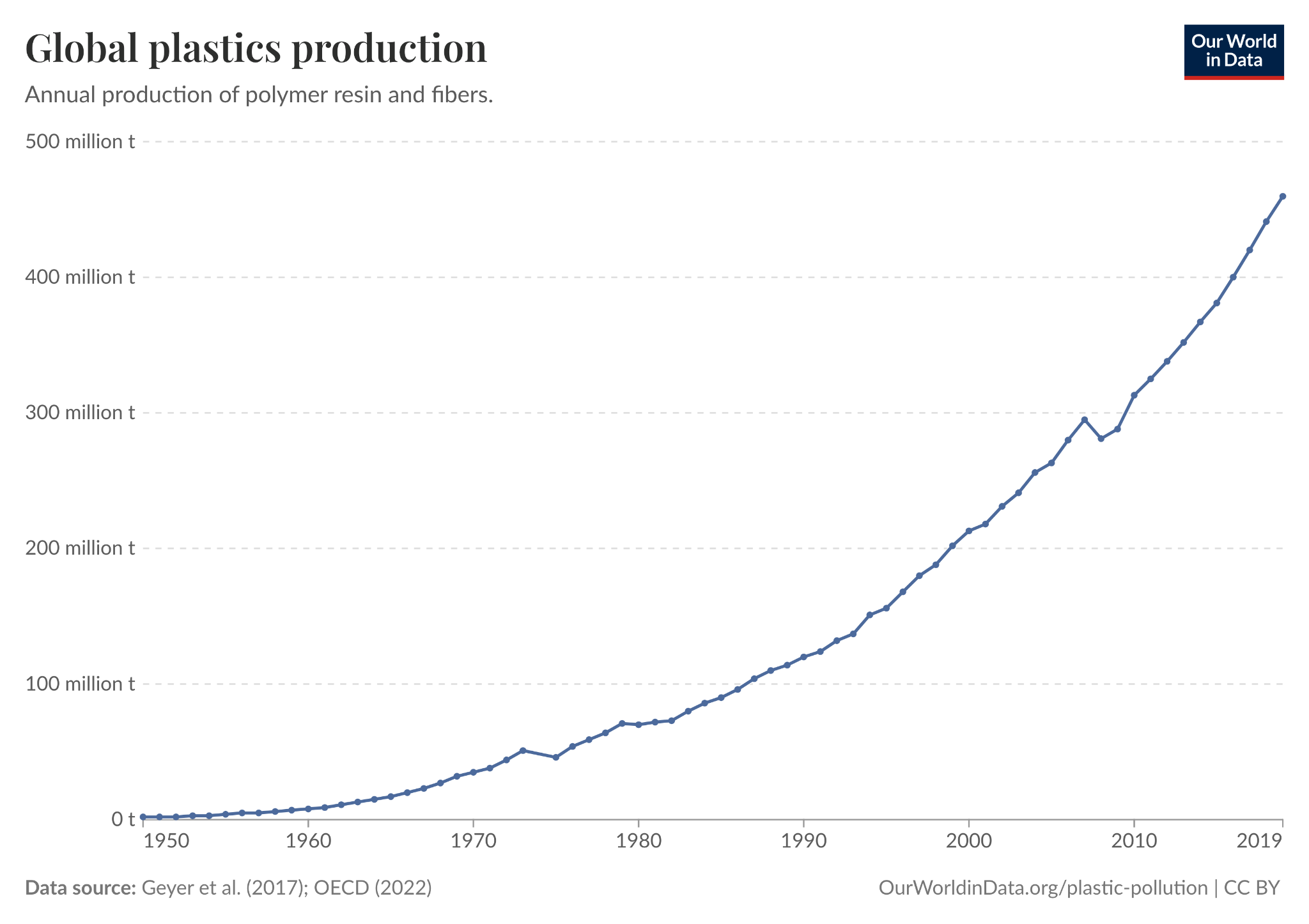
Ever since we’ve learned to make plastic, we’ve made a lot of it. In 1950 the world made around 2 million tonnes a year. By 2019, that number skyrocketed more than two hundred times to over 460 million tonnes a year. Though by mass this is only a fraction of the materials that hold up civilization, just about a quarter of global steel output and a sixty-fifth of concrete.
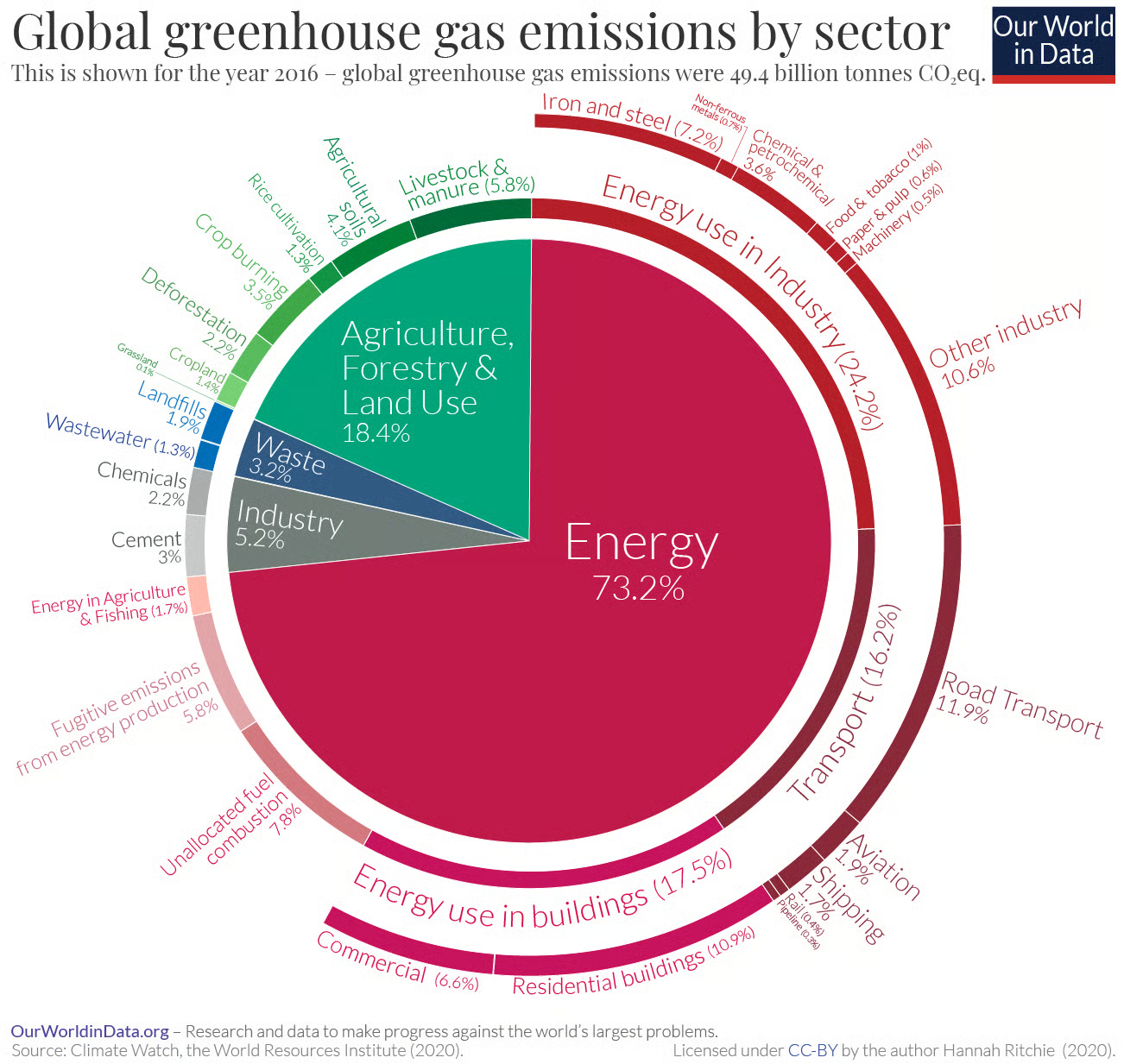
Despite being inseparable from most dimensions of modern life, plastic is still best known as an environmental problem and has a significantly worse reputation than concrete or steel. Cement production alone accounts for 4.5% of global emissions and steel production adds another 7%, while plastics’ entire life cycle contributes roughly 3.3%. It takes roughly 0.038 litres of water to make a plastic bag, compared with 0.14 litres for an unbleached paper bag and 27 litres for a conventional cotton bag. Perhaps the reason plastics have such a bad reputation is their visibility, whereas other industries that are objectively worse on emissions are more contained and invisible to us.
We see this mismatch of attention and resources again and again through bans on bags and on straws, UN treaty negotiations, “reduce, reuse, recycle” chanted in every elementary school, and paper straws meant to save our sea turtles. Plastics are notoriously hard to dispose of naturally, so bans on them are well-intended attempts to cut direct consumer demand. But the most visible part of plastic pollution is not necessarily the most damaging.
The idea that plastic is a harmful material that just happens to have a couple of convenient properties has the causation entirely backwards. Plastic is not useful despite the traits that make it a pollutant, but because of them. It is the only cheap material that is at once mass-producible, inert and lightweight. It’s cheap enough that throwing it away is easier than keeping it. Because it’s synthetic and inert, it’s not designed to naturally disappear and accumulates in colourful mounds that we identify as the classic garbage look.
It’s unrealistic to believe that we can have one half of what plastic’s properties enable without the other.
what even is a plastic
To begin with, plastic is technically not a single material. It’s a class of synthetic or semi-synthetic polymers made of carbon and hydrogen. Some plastics also have extra elements that give them different properties, like chlorine in PVC or fluorine in Teflon.
There are hundreds of variants that are sorted into seven main recycling codes (the seventh being ‘other’), so when people say they’re trying to replace plastic they never ever mean all of them. They’re usually referring to a single application of a specific plastic like low-density polyethylene (LDPE) in food packaging coatings in single-use takeout containers.1
To understand why plastics are so difficult to replace, it helps to look at what they replaced.
mass-producible
Plastics were originally made to replace materials that had a biological supply chain and would have been virtually impossible to scale. Many consumer goods in the late 1800s were made of ivory, silk, horn, and tortoiseshell. One of the first plastics, celluloid, was a semi-synthetic made to replace the ivory in piano keys, pens, and billiard balls. Can you believe that plastic was once the more sustainable material!
Then came Bakelite (in 1907). The first fully synthetic plastic, made from phenol and formaldehyde. It was timed well with the spread of electrical systems and made a great insulator for sockets unlike wood and ceramic that absorbed moisture or broke easily.
As these materials developed, scientists began to understand what gave them their properties. Hermann Staudinger won the Nobel Prize (in 1953) for showing that polymers (of which plastics are a kind) are long chains of repeating units joined by chemical bonds. That meant plastics could be designed with chemistry instead of trial and error.
Having synthetic materials didn’t automatically mean scale. A combination of new manufacturing methods and new materials did. Combs are a neat example.
In the 1930s, combs were made of celluloid, which was, in principle, mass-producible. But in practice, combs had to be molded in small batches and then sawed and polished by hand. The material itself was flammable because it was mostly nitrocellulose (a close relative of gun cotton) and it ignites before it melts. Workers had to be sprayed with water throughout the day.2
Cellulose acetate came next, a material that could soften at a temperature even a home oven could reach without celluloid’s habit of catching fire. You could inject it as a melt and it would set in seconds. With an injection mold, you could get over 10 combs in just under a minute. In 1930, a celluloid comb cost $1, and by the end of that decade, the machine-molded cellulose acetate combs cost about 10 to 50 cents with much lower labor costs too.3
DuPont published a photo in the 1930s of a father-and-son comb maker duo where they stood beside their daily output of 350 celluloid combs and 10,000 injection-molded ones. 4 5

The Second World War accelerated synthetic polymer production too. The U.S. government financed 51 plants after Japan cut off access to rubber. When the war ended, the plants were repurposed to serve consumers. Injection molding made repeatable, intricate shapes cheap. Extrusion made continuous tubing possible, and blow molding made hollow containers. As plastics became easier to make, designers had freedom to create new shapes, feeding the Space Age design look. With that much increased capacity, it made sense to make disposable goods too.

To replace plastics that are cheap enough to throw away, we would have to find a feedstock that matches their cost. Replacing the entire supply of plastic is a very different problem from finding a material that works in a lab or at small scale. A cotton bag weighs around 200g vs 8g for a thin plastic bag, and takes roughly 29x as much energy to manufacture. I haven’t even accounted for the extra land and water we would need to replace the world’s plastic yet.
inert (and flexible)
Plastics don’t rust, rot, corrode or generally react with their contents, which is why certain types can safely store bleach and acids. Teflon aka polytetrafluoroethylene was first used as a gasket for uranium hexafluoride gas in the Manhattan Project. It was one of the few materials that could withstand the gas and was later adapted for nonstick cookware.
Blood used to be stored in glass before being replaced by softer plastic bags. Beyond the obvious problem of glass breaking during transport, glass had some subtler issues. First, glass bottles were gravity fed so during the Korean War medics had to hoist the bottles to get blood flowing to wounded soldiers. This was slow and made for a target for enemies to fire.6 Second, because glass is rigid, air had to be let into the bottle through a vent in the rubber stopper to replace the outflowing blood. The opening increased the chance of air embolism and bacterial contamination.7 Third, blood reacts to glass. The charged surface of glass triggers clotting just like a wound does. Its surface causes hemolysis (rupture) as red blood cells shear against it. Broken RBCs release ADP (adenosine diphosphate) that further activates platelets. PVC softened with DEHP (a phthalate, later found to be an endocrine-disrupting chemical) caused far less of this reaction. Plastic also solved the brittleness problem and you could squeeze and collapse the bag to deliver blood instead of hoisting and venting.

Bringing back an alternative like glass is more likely to cause direct harm by breaking before the patient receives it, as in the 1980s when NICUs ran on glass IV bottles that nurses worried would fall over and break around fragile preemies.8 And single-use glass has a higher carbon footprint than plastic because it’s much heavier to transport and needs to be melted at around 1500°C. Glass doesn’t degrade faster than plastic either! There truly does not seem to be even a half plausible alternative here.
All these types of plastics are so new that almost nothing in nature has evolved to eat them. We’re still in the very early stages of bacteria being able to degrade plastics under narrow conditions. The other option is to modify the material to degrade faster. But then your package could start degrading before you’re done with it.
There is an infamous stat that it takes 450 years for a plastic bottle to degrade, but PET has only existed for 80 years, so no one has watched a bottle decompose. We can run accelerated degradation tests, but nobody really knows.
lightweight
An empty PET bottle weighs so little that it’s almost inconsequential in transport costs but it can still work perfectly well holding your drink or stacked in a warehouse. A 330 mL glass bottle weighs around 200 g, compared to less than 20 g for a similar PET bottle. At scale, you’re adding tonnes to your shipment without actually selling more drink.
You can see even more clearly when the material becomes part of the vehicle itself. The Boeing 787’s airframe is roughly 50% composites by weight. Boeing says it burns 20% less fuel than the aluminum 767 partly because of improved aerodynamics and partly because of a lighter airframe. In cars the weight-to-fuel ratio is clearer, cutting 10% in weight leads to 6-8% better fuel economy.
Unfortunately, the lightness of plastic is also what makes it a more visible problem than concrete, chemicals or steel. It distributes itself into rivers and across land by wind and it is much easier to see 79,000 tonnes of plastic floating in the Great Pacific Garbage Patch than to quantify how much heavier debris lies on the ocean floor. Lightweight plastics can wash into storm drains and clog them, which worsened the Dhaka floods in 1988 and 1998. This led Bangladesh to become the first country to ban plastic bags in 2002. Needless to say, the ban largely failed and per capita consumption tripled by 2020.
cheap
The most interesting way to see plastic’s cheapness is what we can afford to do with it at scale. Having a feedstock that we already extract and process in enormous quantities helps make this possible. America’s ethane supply is plentiful and cheap, and you only need a small amount of it to make thin films. Polyethylene or PE was discovered by accident (in 1933) when a waxy solid was found in a reaction tube. PE is now 36% of non-fibre plastic production used mostly in packaging.
Food packaging in plastic also works because the material doesn’t feed microbes and multilayer films slow rancidity by keeping almost all the oxygen out.9 This both extends shelf life and makes the globalization of food possible. Throwing away a single unwrapped cucumber has the same climate impact as the plastic used to wrap 93 of them. Using plastic crates instead of sacks cut tomato shipping losses from 16.7% to 2.2% and beef lasts a lot longer when packed in plastic.10
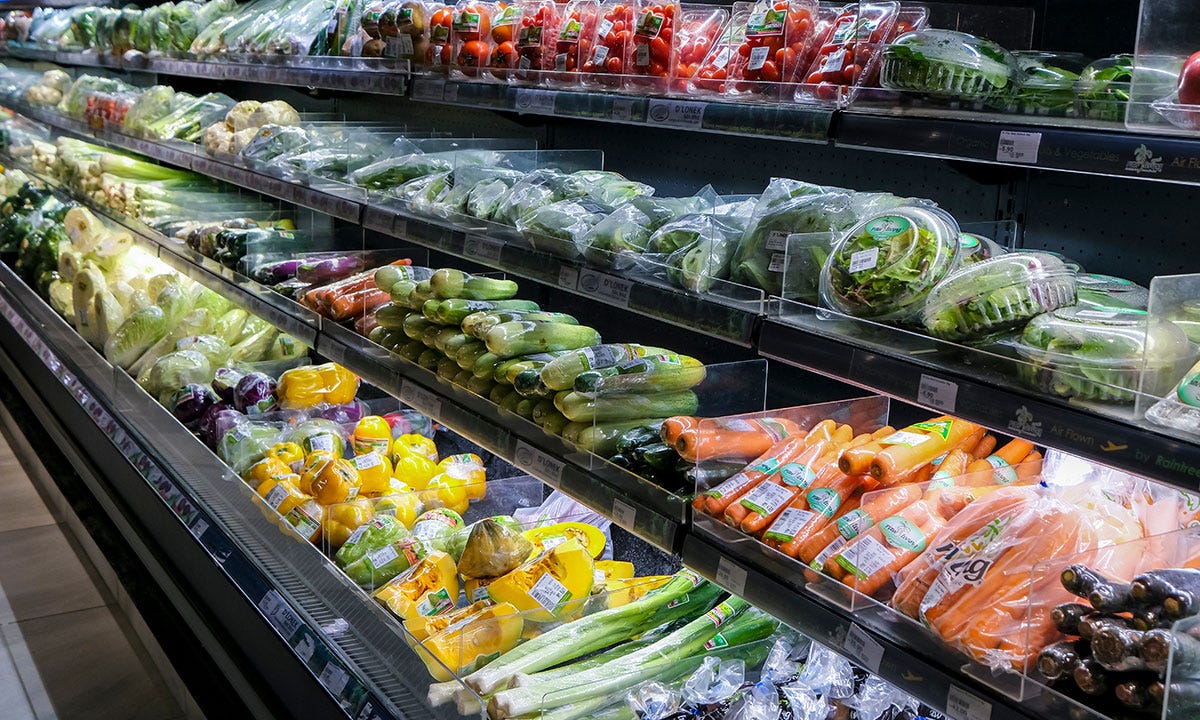
This is a fairly normal part of eating now. The FDA reported in 2019 that other countries supplied about 55% of the fresh fruit and 32% of the fresh vegetables consumed in America. Replacing plastic in food packaging would cause the food to be a lot more expensive and fewer people being able to afford it.
The cheapness of plastics also makes it possible to open a fresh syringe for every patient without thinking about it twice. Just in the year 2000, reusing syringes caused about 21 million hepatitis B, 2 million hepatitis C, and 260,000 HIV infections. By 2010, syringe reuse fell from about 40% to 5.5%, and injection-related HIV infections fell 87%. The WHO estimated the world needed 89 million masks and 76 million gloves per month in March 2020, when COVID was spreading worldwide. There is effectively no other material we could produce at volumes so high at so low a cost. Trying to reuse PPE instead would likely have cost lives.
what if we just made a new plastic
These four qualities (mass-producible, inert, lightweight, cheap) reinforce each other.
To replace plastics you have to replace each type, which means either displacing existing machinery or making a new material compatible with it. And it still has to match their properties and costs.
A lot of companies use bio-based plastics, which are different from bioplastics. The former are plastics made from crops like corn instead of petroleum but have the same exact chemical structure and the same degradability (or lack thereof) as regular plastic. They sound greener but end up as the same material, which takes us back to square one.
The focus on alternative materials assumes that replacing plastic is better for the environment than continuing to use it. It also assumes that we have an alternative simply waiting for consumers to adopt it. In most cases neither of these assumptions hold.
the actual problems with plastic
All this is not to say plastics are entirely harmless, but their harm falls into two categories.
1) health
Finding plastics in the human body is unsettling, but finding something and establishing what it really does to us are different tasks. Microplastics11 could be a legitimate health concern, but we need better evidence about the risks at the amounts we actually encounter.
The rise of plastics has also coincided with a substantial increase in global life expectancy. That doesn’t establish their safety or anything, but it does mean that any account of plastics’ effects on health has to include the sterile equipment, clean water infrastructure, and food preservation that help make the modern world livable.
Endocrine-disrupting chemicals are a different story here.12 They can mimic, block, or interfere with hormones and are sometimes used in plastics, amongst other things like skin products, flame retardants, candles, cosmetics and so on.13 Endocrine disruptors are more active in interfering with the human body than microplastics. While the body is more sensitive to these chemicals, eliminating plastic as a material wouldn’t actually eliminate the problem here.
2) pollution
Asia accounts for about 81% of plastics entering the ocean through rivers. These estimates are particularly for river emissions rather than every source of plastic in the ocean, but the amount of plastic we use doesn’t directly translate to how much ends up in the sea.
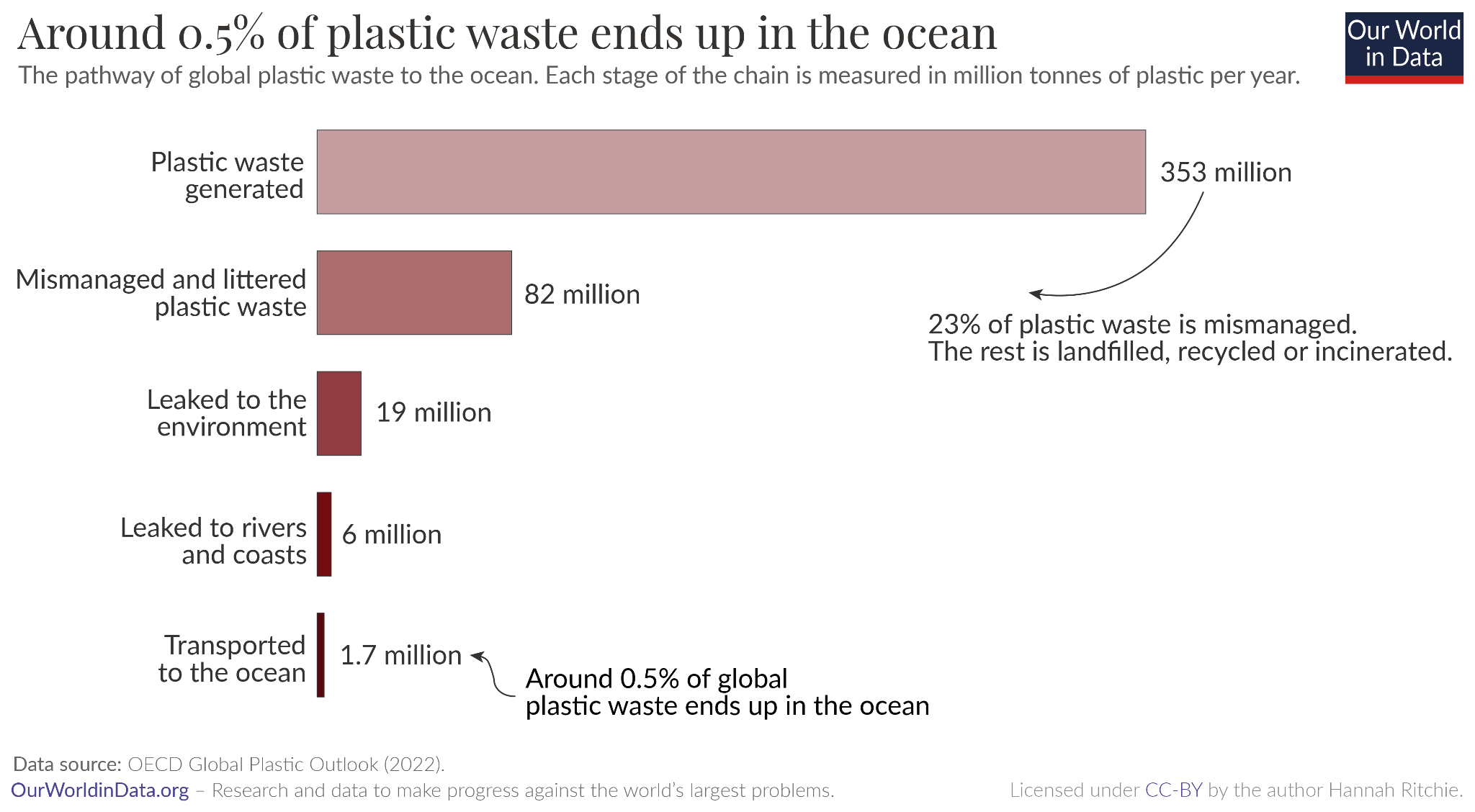
The Ciliwung river basin in Java produces about 75% less plastic waste than the Rhine basin in Europe, yet it’s estimated to send roughly 100 times more into the ocean. Waste management is a factor but so is geography. Heavy rainfall, waste generated near rivers and shorter distances to the coast all make it more likely to reach the sea. Rich countries also sometimes export their plastic waste for recycling but not all of it is managed well. Some end up burned as fuel for cooking.
There are obviously good ecological reasons to keep plastics out of the ocean. But keeping plastic out of the environment is a different task from finding a replacement for everything we make from it.
We keep making plastic because it’s just so good at what it does. We also keep failing at replacing it, not because we’re careless or short-sighted or stupid, but because it does a long list of jobs better and more cheaply than anything else we know how to make. Every alternative we’ve tried so far works in a lab or in a niche context, but has no conceivable pathway to scale hundreds of millions of tonnes per year. Say we started over and set out to design a material that was mass-producible, inert, flexible, lightweight, and cheap, hoping that this time it would be biodegradable.14 Congratulations, you’ve just made a new plastic from first principles.15
My vision is that plastics won’t be replaced by slightly greener plastics. They will need to be replaced the way they replaced ivory and shellac, by a new class of materials that scale.
I once toured a seaweed-based plastic replacement company under the guise of a reporter. Their marketing was incredible. They had a bunch of press, a lot of investment, a big London office, and a big team. But once I got there, it was clear that the material couldn’t hold its own shape and only worked as a coating on something sturdier. Minus the glam they were just making lines for takeout containers, nowhere close to being a generic replacement for plastic.
Freinkel, Plastic.
Freinkel, Plastic.
“Employee Charles Sheehan at DuPont Company’s Leominster, Massachusetts Plastics Plant,” c. 1955. Hagley Museum and Library. https://digital.hagley.org/1972341_2429.
“Employee John Sheehan at DuPont Company’s Leominster, Massachusetts Plastics Plant,” c. 1955. Hagley Museum and Library. https://digital.hagley.org/1972341_2421.
Freinkel, Plastic.
Ausman and Bellamy, American Journal of Surgery, 1984. https://doi.org/10.1016/0002-9610(84)90318-0
Freinkel, Plastic.
3-7 days in overwrap, 10-14 in modified-atmosphere packs and 35-45 vacuum-packed -- all of which are made of plastic wrapping.
Microplastics are mechanically broken down from plastics and are mostly inert
Endocrine disruptors are chemicals that interact with the body in ways that mimic hormones, which can cause reproductive and fertility issues. You can learn more here.
PLAs and PHAs are steps in the right direction, but both of them are still more expensive than fossil plastics because of sugar fermentation costs and also can't meet plastics' performance across most uses. Some of these types of compostable plastics also need to be sorted and sent to a specific facility to be processed and composted, and won’t break down in just a regular landfill
Making a plastic biodegradable still makes it plastic, just one that breaks down.
Sobering. I think for now, stricter rules on littering and incineration are wise. The thing about the junk in developing countries is every country went through its littering phase but there is something undeniably yucky, permanent, and leaves you with a feeling of intractability that plastic pollution shows-that too the sense that its forever in your body that makes it loom a lot larger than a piece of scrap steel or a degradable icecream cone chucked in a bush. Currently developed countries didn't have to develop with the prospect of plastic pollution, and it sucks even in developed countries, all the more so in poorer ones. I think our collective instincts might just be right here but this essay is a good reality check to that. Maybe mushroom variants are our next bet.
I think it's permanent as part of our medical supply, maybe for the next century but perhaps forever.